 English ▾
 Nederlands
 English (US)
 Deutsch
 Italiano
 Português
 Español
 Français

Dentistry is the most procedural of the health degrees, and that is exactly why a dental elective abroad needs more thought than a medical one. Almost everything a dentist does is invasive. A medical student can learn a great deal on a ward round without touching anyone. A dental student who is handed a syringe or a pair of forceps abroad is one step from operating on a patient without the supervision, registration or infection-control safeguards they would have at home. Most of what you find online skips this. Provider pages promise “hands-on experience” without explaining what the General Dental Council (GDC) expects of students, what your defence organisation will and won’t support, or why sharps safety matters more for you than for any other student on the trip.
This guide covers those points: the rules behind your degree, scope of practice, blood-borne virus risk, indemnity, the oral health picture you will actually see, a destination comparison, costs, and how to get the elective approved. It is written for UK BDS students, for dental hygiene and therapy students, and for the elective leads who sign the forms. It follows the same format as our guides for student nurses, student midwives and physiotherapy students.
What a dental elective abroad actually is
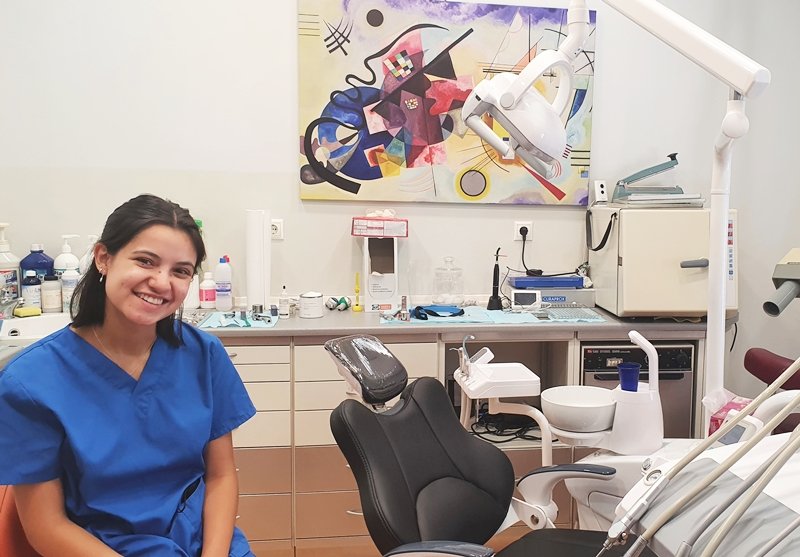 Most UK dental schools build a self-directed elective into the later years of the BDS. The details vary a lot. At Dundee the elective lasts four weeks and can be done locally, nationally or internationally. Newcastle gives students up to eight weeks at the end of Stage 4 to travel, attend clinics at home or overseas, or do research. Glasgow builds a period of elective study into year 3, with a project that students present afterwards, and many travel abroad for it. Some schools want a clinical placement, some want a research or public-health project, and most want a report.
An overseas elective usually takes one of three forms: time in a dental school or teaching hospital abroad, a community or outreach oral-health project, or an observation-led placement in clinics. In all three, the realistic model for a student is supervised and largely observational. You shadow dentists and oral surgeons, discuss treatment planning, help with oral-health education and, where the host and your competence allow, assist at the chairside. You don’t run your own list.
The rules behind your degree
Nursing and physiotherapy degrees are built around a set number of practice hours. Dentistry is different. The GDC’s requirements describe the behaviours and outcomes you must show by graduation, so an elective abroad is not a way to top up hours. Its value lies in the learning outcomes your school approves.
| Source | What it says | What it means abroad |
|---|---|---|
| GDC Safe Practitioner framework | The framework of behaviours and outcomes for dental education. It took effect on 1 August 2025, replacing Preparing for Practice, and all providers are to be mapped against it by 2030/31 | Professionalism and insight are assessed alongside clinical skill. How you behave on elective is part of that picture |
| GDC Standards for the Dental Team | Principle 7 requires dental professionals to work within their knowledge, skills, professional competence and abilities | Students are expected to follow the same standards. Unprofessional behaviour during training can affect your ability to register later |
| Host-country law | Every country sets its own rules. Some allow dental students to work under supervision. Others require a completed dental degree before you can treat anyone | Ask the host to confirm in writing what a visiting student is permitted to do |
| Defence organisations | Dental Protection, for example, supports student electives where the elective is authorised by your Dean, notified before travel, supervised by a qualified dental practitioner and within your competence | If you step outside supervision or competence, you may step outside that support |
| NHS Fit for Travel | Medical, nursing and dental students should not carry out procedures abroad that are beyond their level of competence in the UK | The UK benchmark travels with you, whatever the host offers |
The key point: your UK student status does not travel with you. At home you treat patients as an enrolled student on your dental school’s clinics, under its registered staff. Abroad, that arrangement doesn’t exist. What you may do is set by the host country’s law, the host institution’s policy and your own school’s elective rules, and the strictest of the three wins.
Scope of practice: what you can and can’t do
 The same test applies in dentistry as in medicine: don’t do abroad anything you wouldn’t be allowed to do, competently and under supervision, at home. In practice that sorts activities into two groups.
Usually appropriate (with the host’s agreement and direct supervision)
- Observing examinations, radiograph interpretation and treatment planning, then discussing the reasoning with the dentist
- Watching restorative, endodontic, periodontal, orthodontic and oral surgery procedures
- Chairside assisting: suction, instrument transfer, mixing materials
- Supporting instrument decontamination and seeing how sterilisation works with limited resources
- Oral-health education, toothbrushing instruction and school or community outreach sessions
Not appropriate for a student
- Giving local anaesthetic, extracting teeth or cutting cavities without the direct supervision you would have on a UK student clinic
- Any procedure you have not yet been signed off for at your own dental school
- Prescribing, or taking radiographs outside local radiation-protection rules
- Working alone at a camp or outreach clinic “because there is no dentist today”
The last point is the classic trap. In places with very few dentists, a willing student can look like extra capacity. An extraction can’t be undone, and a patient in a low-resource setting has the same right to a qualified operator as a patient in Leeds. Saying no politely is the professional answer. Our guide Are medical electives ethical? covers how to handle it, and our older piece on whether overseas experience helps with dental school looks at the applicant’s side.
Sharps and blood-borne viruses: the risk dental students underestimate
Under UK guidance, most operative dentistry counts as an exposure-prone procedure: your gloved fingers work next to needles, burs, scalers and sharp tooth edges inside a confined space. That is why UK dental students go through blood-borne virus health clearance before they start on clinics. Abroad, the same procedures carry more risk, for three reasons.
- Prevalence may be higher. The WHO estimates that 254 million people were living with chronic hepatitis B in 2022, most of them in Africa and Asia.
- Systems may be thinner. Sterilisation capacity, safety syringes and sharps disposal vary between clinics.
- Post-exposure treatment may be harder to reach. NHS Fit for Travel advises that HIV post-exposure prophylaxis (PEP) should start as soon as possible, and within 72 hours, and that the course lasts 28 days.
So before you travel, confirm your hepatitis B immunity with occupational health, ask the host how instruments are sterilised and where the nearest source of PEP is, and check whether your travel insurance covers a needlestick injury. Fit for Travel warns that insurers may not pay HIV-exposure costs if a student was doing work beyond their competence. Our vaccinations and visas timeline shows when to start each step.
Indemnity and insurance
You need two different kinds of cover, and students often mix them up.
- Professional indemnity or defence-organisation support. Student membership of a dental defence organisation is usually free, and many dental schools expect it. At the time of writing, Dental Protection offers elective support free to student members who meet the conditions in the table above, and it issues a membership certificate you can show your host. Australia is a special case, because students there must hold local insurance, which Dental Protection arranges through MIPS. The DDU says student members can ask for its help with problems arising from patient care on elective. MDDUS advertises free elective indemnity for student members, again with an exception for Australia. Terms differ, so contact your own organisation with your dates and destination before you go.
- Travel and medical insurance. Defence organisations don’t cover your own illness, injury or cancelled flights. That needs a separate policy.
Med Trips includes medical insurance in the programme fee. Professional indemnity remains yours to arrange. Our elective insurance and indemnity guide explains the difference in detail.
The clinical picture: why oral health abroad is so instructive
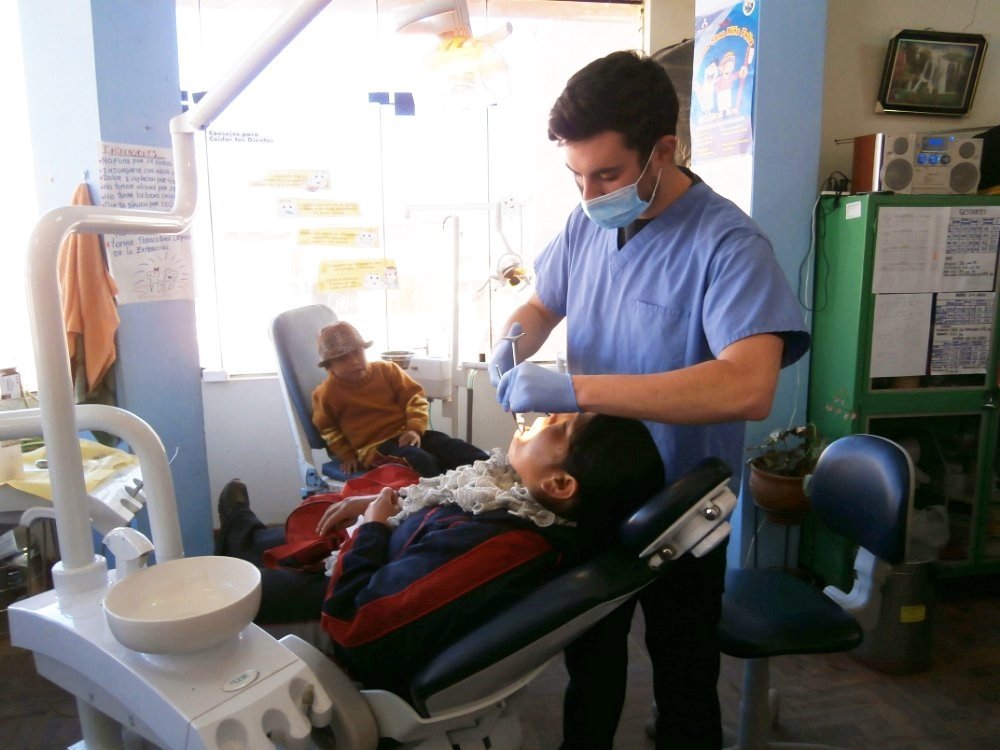 Oral disease is the most common health condition on earth, and most of it goes untreated. The WHO’s Global Oral Health Status Report (2022) estimates that oral diseases affect close to 3.5 billion people, about 45% of the world’s population, and that three in four of them live in low- and middle-income countries. Untreated decay in permanent teeth affects around 2 billion people, and decay in primary teeth affects 514 million children. Severe gum disease affects about 1 billion people.
The workforce gap is just as stark. The WHO African Region recorded 3.3 dentists per 100,000 people between 2014 and 2019, about one-tenth of the global ratio. Around 70% of sub-Saharan African countries spent less than US$1 per person per year on oral health care in 2019. That shapes what you will see:
- Late presentation. Pain is often the first reason to attend, so you’ll see advanced caries, abscesses and facial swellings that UK dentistry usually catches years earlier.
- Extraction-led care. Where restorative materials, endodontics and laboratory work are scarce or unaffordable, taking the tooth out is often the only realistic treatment.
- Oral cancer and trauma. Around 380,000 new oral cancer cases are diagnosed worldwide each year, and maxillofacial units in some regions see more road-traffic trauma than most UK students will meet in training.
- Prevention as policy. School toothbrushing and fluoride programmes are often the most effective dentistry on offer, and a good place for a student to be useful.
The opposite experience has value too. A placement in a well-equipped European clinic lets you compare private-practice workflows, materials and specialist referral with what you know from the NHS. Either way, reflecting on the differences without judging them is what makes a strong report. Our reflective report template was written for medics, but the structure works for dentistry too.
Where to go: comparing destinations for dentistry
Med Trips runs two dedicated dental programmes and offers dentistry as a department on several multi-specialty hospital placements. All are supervised by local clinicians and supported by our in-country teams.
| Destination | Dental setting | Language | Best for |
|---|---|---|---|
| Greece, Athens (dedicated programme) | Busy dental clinics. Shadowing only by design: students don’t perform procedures. Specialties can include endodontics, orthodontics, periodontics, prosthodontics, paediatrics and oral surgery | English-speaking dentists | Early-year and pre-dental students, and anyone whose school wants a strictly observational elective. 2–12 weeks |
| Peru, Cusco (dedicated programme) | Local hospitals and clinics, plus oral-hygiene teaching in schools and kindergartens. Weekday mornings. Involvement depends on your experience and the supervising dentist | Spanish. Intermediate level required | Spanish speakers interested in community and paediatric dental public health. 1–12 weeks |
| Tanzania, Kenya and Ghana | Dental department within a multi-specialty hospital placement | English among clinicians. Swahili, Twi and other languages with patients | Seeing late-presenting disease and how a public dental service runs with very few dentists |
| Thailand and Sri Lanka | Dental department within a hospital placement | Thai or Sinhala with patients. Clinical English among staff | Combining dentistry with time in other hospital departments |
If your school insists on observation only, the dental elective in Greece is the simplest to get approved, because its scope is fixed in writing. If you speak Spanish and want public-health work, look at the dental elective in Peru. All options are listed on our dentistry electives page.
What it costs
Expect four cost blocks: the programme fee, flights, vaccinations and visa, and personal spending. As examples, at the time of writing the Greece dental programme was priced from £1,879 for two weeks to £2,913 for four weeks, including shared accommodation and medical insurance but not meals. The Peru dental programme ran from £876 for one week to £1,568 for four weeks, including a homestay with weekday meals and medical insurance. Current prices in your currency are on our prices page, and our 2026 cost data breaks down the extras by region.
On funding, be realistic. Dental Protection’s own advice to students is that you are unlikely to get your whole elective funded and should plan to pay for most of it yourself. Start with your dental school’s elective and travel funds, then look at alumni awards and prizes from specialist societies. Your elective lead usually keeps the current list.
Getting it approved: a step-by-step checklist
Start 9–12 months ahead. Hosts, deans and defence organisations all work to their own timetables.
- Read your school’s elective rules. How long is it? Must it be clinical, or can it be a project? Does the school limit what you may do abroad?
- Agree learning outcomes with your elective lead, for example “compare caries management in a low-resource public clinic with UK practice”.
- Get the host’s terms in writing: the supervising dentist’s name and qualification, what visiting students are permitted to do, and your weekly hours.
- Complete the risk assessment using FCDO travel advice. Our elective sign-off guide walks through the paperwork, which is very similar for dentistry.
- Notify your defence organisation with your dates and destination, and arrange travel and medical insurance.
- See occupational health about hepatitis B immunity and travel vaccines, and ask about access to PEP.
- Plan your evidence: a reflective log, a supervisor’s attendance letter and the report or presentation your school requires.
Going as a cohort: dental societies and university groups
Dental schools and student dental societies increasingly travel as a group, often with a member of faculty. One agreed scope of practice, one risk assessment and one supervision plan cover the whole cohort, which makes approval simpler for the school. If you are a lecturer or society organiser, see our university group placements page and the step-by-step guide to organising a group elective. Mixed cohorts with medical and nursing students work well for outreach projects, where oral health is part of general health.
Why the provider you choose matters
Any provider that advertises a dental elective by promising extractions and injections for students is telling you something about how it treats patients. Before booking with anyone, ask three questions: Who will supervise me, and what are their qualifications? What exactly am I permitted to do, in writing? Who supports me on the ground if something goes wrong? Med Trips is part of a certified B Corp group, which means independently verified standards of accountability. Our placements are built to be observation-appropriate for students, and in-country teams handle arrival, accommodation and day-to-day support.
Frequently asked questions
Can dental students treat patients on an elective abroad?
Only where host-country law and the host institution allow it, under direct supervision, and within what you have been signed off for in the UK. Some countries require a completed dental degree before anyone can treat. Many electives, including our Greece programme, are observation only.
Does a dental elective abroad count toward my BDS?
That is your dental school’s decision. The GDC framework is based on outcomes, not placement hours, so schools usually assess the elective through a report, project or presentation. Get your plan approved before you book.
Am I covered by indemnity on a dental elective abroad?
Usually yes, if you are a student member of a defence organisation and meet its conditions, which typically include school approval, advance notice, supervision and working within your competence. It doesn’t replace travel and medical insurance. Always confirm current terms with your organisation.
How long should a dental elective be?
It depends on your school: Dundee’s elective is four weeks, while Newcastle allows up to eight. Our dental programmes run from one or two weeks up to twelve. Two weeks is the realistic minimum to settle in and see a range of cases.
Which country is best for a dental elective?
For a structured, English-language, observation-only placement, Greece. For Spanish speakers who want community dental public health, Peru. For exposure to late-presenting disease in a system with very few dentists, Tanzania, Kenya or Ghana.
Plan your dental elective
Compare dates and destinations in our programme search, or talk to our team about supervision, scope of practice and what your dental school needs to see. Organising for a whole year group or dental society? Start with our group elective page. Not yet at dental school? Our pre-medicine placements are designed for applicants, and the Greece dental programme accepts pre-dental students too.