 English ▾
 Nederlands
 English (US)
 Deutsch
 Italiano
 Português
 Español
Most UK nursing degrees give you one chance to choose your own placement: the elective. For a growing number of student nurses, that choice is a hospital abroad. Yet the information available is strangely thin. Provider pages describe the experience as life-changing; very few explain what the Nursing and Midwifery Council (NMC) actually requires, whether your overseas hours will count, who is allowed to supervise you, or what you can and cannot do on the ward.
This guide answers those questions. It covers the NMC numbers your programme has to deliver, how the Standards for student supervision and assessment apply abroad, scope of practice, indemnity, realistic costs, how to choose a destination for your field of nursing, and how to get the placement approved. It is written for UK student nurses in all four fields — and for the placement and practice-learning staff who have to approve it. It is a companion to our guide for student midwives.
What a nursing elective abroad actually is
 An elective is a placement you select, usually outside the core placement circuit your university has built to deliver the NMC proficiencies. Most UK nursing programmes place it in the second or third year, typically for two to six weeks. At King’s College London, for example, second-year nursing and midwifery students can take an elective of 150 hours across a four-week period, in the UK or overseas. Some universities make the elective optional; many expect students to self-fund the overseas version.
Overseas nursing electives are, in practice, supervised and largely observational. You join local nurses on the wards, in theatres, clinics and community outreach, observe care and support basic tasks within clearly defined limits. You do not take a patient caseload. That is not excessive caution on the part of a provider — it follows directly from how UK nursing education is regulated, as the next two sections explain.
The NMC numbers your programme must deliver
The NMC’s Standards for pre-registration nursing programmes (updated in 2023) set out the structure every approved UK nursing degree must follow. Knowing these numbers explains where an elective fits — and where it does not.
| NMC requirement | The minimum |
|---|---|
| Programme length (full time) | Equivalent of three academic years, minimum 4,600 hours |
| Theory | At least 2,300 hours |
| Practice learning | At least 2,300 hours |
| Simulated practice learning | Up to 600 of the 2,300 practice hours (doubled from 300 in 2023) |
| Fields of practice | Adult, children’s, mental health and learning disabilities nursing — students qualify in one field but programmes must give experience relevant to all four |
| Supervision and assessment | Governed by the NMC Standards for student supervision and assessment (SSSA) |
Two points follow. First, the 2,300 practice hours are designed around a placement circuit your university controls and audits; an elective is a small slice of that total, not a substitute for it. Second, whether your elective hours count at all is a decision for your university (your approved education institution, or AEI), not for the placement provider. Some programmes count elective hours toward the 2,300; others treat an overseas elective as enrichment that sits alongside the required hours. Find out which applies to you before you book.
Do overseas hours count? How the SSSA applies abroad
The NMC’s own supporting guidance is explicit that elective placements may be international, or in settings with no NMC-registered professional present. But it adds an important condition: any placement where proficiencies are to be met and programme hours achieved must meet the requirements of the NMC’s Standards framework for nursing and midwifery education, with the safety of people as the primary consideration. Documentation and evidence requirements are the same for international and elective placements as for any other placement.
In practice, three SSSA roles decide whether your hours can be counted:
- Practice supervisor. This can be an NMC-registered nurse, midwife or nursing associate, or another registered health or social care professional. The NMC’s guidance confirms that nurses registered in their own country fall into the category of “other registered professionals” — so a registered local nurse at your overseas hospital can act as your practice supervisor. Unregistered staff can contribute, but cannot be your primary supervisor.
- Practice assessor. This must be an NMC-registered professional with appropriate experience. Overseas hosts rarely have one on site, which is why most universities keep assessment of proficiencies at home and treat the elective as supervised learning with documented evidence.
- Academic assessor. Your university-side assessor, who works with the practice supervisor and practice assessor. Effective planning and communication between all three is what the NMC expects.
The NMC also notes that a one-off international placement does not have to be declared as a new practice learning partner, but your AEI remains responsible for risk assessment and oversight, and you must know the nominated person for your international practice setting. Put simply: the paperwork, not the destination, is what makes overseas hours count. A provider that can name your supervising nurse, confirm their registration and complete your university’s forms makes this straightforward. Read more on how we handle this on our elective supervision page.
Scope of practice: what you can and cannot do
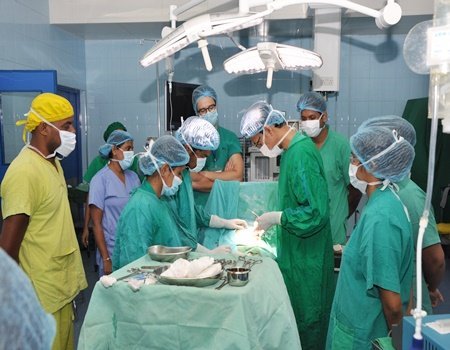 The guiding principle, shared by UK regulators and professional bodies, is simple: do not do abroad anything you would not be permitted and competent to do at home, at your stage of training, under supervision. Lower-resource settings sometimes create pressure to step beyond that line — a busy ward, a short-staffed shift, a kind invitation to “have a go”. Saying no protects patients, your host colleagues and your future registration.
On a typical Med Trips nursing elective you can expect to:
- observe nursing care across wards, theatres, emergency, maternity, paediatric and community settings;
- take part in handovers, ward rounds and patient education where language allows;
- support basic, non-invasive care under direct supervision where the host hospital and your stage of training permit;
- join community outreach and health-education activities.
You should not expect to administer medication, perform invasive procedures or provide independent patient care unless a specific programme explicitly supports it and your university has agreed. Our scope of practice policy sets this out in full, and our guide to whether medical electives are ethical explains why these boundaries matter.
Indemnity, insurance and visas
Three separate protections are often confused:
- Professional indemnity covers claims arising from your clinical activity. The Royal College of Nursing states that its indemnity scheme covers student members on elective placements abroad, subject to its conditions and exclusions — notably, it does not cover claims made in the USA or Canada. Check your own membership terms before you travel.
- Medical and travel insurance covers your own health, repatriation and belongings. Med Trips includes medical insurance in the programme fee; check whether you need extra cover for valuables, activities or trip cancellation.
- Visas. The RCN advises students not to describe their elective as “work” when applying for entry, since that can be read as paid employment. Describe it accurately as an unpaid educational placement that forms part of your UK course, and apply for the visa category the destination specifies.
Our full guide to elective insurance and indemnity covers the detail. Always confirm current visa rules with the relevant embassy, as they change.
Choosing a destination by field of nursing
The right destination depends less on the country than on the clinical settings you want to see, the language spoken on the wards and the time you have. The table below summarises the destinations where Med Trips offers nursing placements. Prices are the current starting prices for the shortest duration and change with length of stay — see live figures on our prices page.
| Destination | Settings often available | Durations | From | Particularly suits |
|---|---|---|---|---|
| Kenya | General wards, maternity, emergency, community outreach | 1–12 weeks | £604 | Adult and children’s nursing; first-time travellers on a budget |
| Tanzania (Arusha) | Hospital wards, maternity, outpatients, outreach | 1–12 weeks | £715 | Adult nursing; infectious disease and public health interest |
| Nepal | Government and teaching hospitals, community health | 2–12 weeks | £791 | Community and public health; resource-limited care |
| Vietnam | Large hospital departments, rehabilitation | 2–12 weeks | £902 | Adult nursing; high-volume urban care |
| Thailand (Chiang Mai) | Hospital rotations alongside Thai clinicians | 1–12 weeks | £927 | Shorter placements; a well-organised health system |
| Cambodia | Hospital wards in a system with significant equipment limits | 2–12 weeks | £1,023 | Students interested in resourceful, low-tech care |
| Morocco (Rabat) | Multidisciplinary hospitals and clinics | 2–24 weeks | £1,119 | French speakers; longer placements |
| Greece | Rotations with English-speaking local professionals | 2–12 weeks | £1,879 | Students wanting a European health system |
| Sri Lanka | Hospital wards, theatres, rehabilitation | Flexible | See prices | All fields; a long-established nursing placement |
By field of nursing
- Adult nursing: almost every destination works; high-volume general wards in Kenya, Tanzania or Vietnam offer the broadest case mix.
- Children’s nursing: ask specifically about paediatric wards before booking — availability varies by hospital. Our guide to what to expect on a paediatric elective covers consent and safeguarding abroad.
- Mental health nursing: psychiatric placements are more limited and depend on host capacity; tell us your field early so we can check what is genuinely available rather than promising a rotation that does not exist.
- Learning disabilities nursing: specialist services are less common in many destinations; community and rehabilitation settings can offer relevant learning. Discuss options with us before you apply.
What it costs
Programme fees cover your placement, accommodation, in-country support and medical insurance; check each programme page for exactly what is included. Flights, vaccinations, visas and spending money are extra. For a four-week placement, the programme fee itself depends on destination and duration (see current prices); on top of that, many UK students budget roughly £500–£1,000 for return flights depending on season, £100–£400 for vaccinations and £50–£200 for a visa. Our 2026 elective cost data breaks this down line by line.
For funding, check your university’s travel scholarships first — King’s College London, for instance, offers several £750 international travel scholarships for nursing and midwifery electives. The UK’s Turing Scheme runs its final year in 2026/27 before the UK rejoins Erasmus+ from 2027/28, and funding flows through universities rather than to individuals. The RCN also offers bursaries and awards. See our elective funding page and bursaries and grants guide.
Getting your nursing elective approved: a timeline
 The RCN suggests starting several months ahead and contacting potential hosts around five to six months before you travel. A practical sequence:
- 9–12 months before: read your programme’s elective guidance; confirm whether hours count and which forms apply.
- 6–9 months before: shortlist destinations by field and language; request supervisor details and the provider’s risk-assessment information.
- 5–6 months before: submit your elective proposal with learning outcomes mapped to your proficiencies; book once approved.
- 3–4 months before: visit a travel health clinic, check passport validity (many countries require six months remaining), apply for visas, confirm indemnity. Our pre-departure timeline lists each step.
- On placement: keep a reflective log and get supervisor sign-off as you go — not on the last day.
- After you return: complete your reflection or report. Our reflective report template was written for medical students but the structure transfers directly to nursing.
Our sign-off support page explains what documentation we provide for universities.
Running a nursing elective for a whole cohort
If you are a lecturer, practice-learning lead or nursing society organiser, a group placement can be simpler to approve than many individual ones: one risk assessment, one supervision arrangement and one point of contact. Med Trips runs university group placements for nursing and medical cohorts, including custom group programmes in Sri Lanka, Thailand and Tanzania. Our faculty guides to organising a group elective and safeguarding and risk assessment walk through the process.
Why students choose Med Trips
Med Trips is part of a certified B Corp group, which means our social and environmental practices are independently assessed rather than self-declared. Placements are in hospitals we have vetted, supported by in-country teams who meet you on arrival and remain available throughout, with 24/7 emergency support and medical insurance included. We are open about the limits of what a student nurse should do abroad, because that is what makes an elective approvable. You can read more about us, or compare all our nursing elective placements alongside related midwifery, physiotherapy and medical electives.
Frequently asked questions
Do nursing elective hours abroad count toward the NMC’s 2,300 practice hours?
They can, but only if your university decides they do and the placement meets the NMC’s Standards framework, with the supervision and documentation your programme requires. Some universities count elective hours; others treat an overseas elective as additional learning. Confirm with your placement team before booking.
Can a local nurse abroad be my practice supervisor?
Yes. NMC guidance confirms that nurses registered in their own country count as “other registered professionals” who can act as practice supervisors. Your practice assessor, however, must be NMC-registered, which is why proficiency assessment usually stays with your UK team.
Can I give medication or do procedures on a nursing elective abroad?
Generally no. Electives are supervised and largely observational, and you should never do anything abroad that you would not be permitted and competent to do in the UK at your stage of training. Any hands-on activity must be within your competence, supervised and agreed with your university.
Am I covered by RCN indemnity overseas?
The RCN states that its indemnity scheme covers student members on overseas electives, subject to its conditions, but not for claims made in the USA or Canada. Indemnity is separate from medical and travel insurance, which you also need. Always check current terms with the RCN.
How long should a nursing elective abroad be?
Most UK programmes allow two to six weeks, and four weeks (around 150 hours) is common. Med Trips nursing placements run from one week up to 12 weeks or longer in some destinations, so you can match the placement to your programme’s elective window.
Plan your nursing elective
Start by checking your university’s elective rules, then search nursing placements by destination and dates. If you would like help matching a placement to your field, your university’s paperwork or a cohort trip, contact our team — or, if you are planning for a whole cohort, see our group elective options for universities.
Regulatory details in this guide reflect NMC and RCN guidance as published at the time of writing. Standards, indemnity terms and visa rules change, so always confirm current details with your university, the NMC, your professional body and the relevant embassy.