 English ▾
 Nederlands
 English (US)
 Deutsch
 Italiano
 Português
 Español
 Français
Physiotherapy students get fewer chances than medics to choose where they learn. Most of your 1,000-plus practice hours are allocated by your university, often close to home. The elective, where your programme offers one, is the exception, and more UK physio students are using it to work in a rehabilitation unit abroad. The trouble is that most of what you find online is marketing. Provider pages promise “hands-on experience” without explaining what the Chartered Society of Physiotherapy (CSP) and the Health and Care Professions Council (HCPC) actually require, whether the hours will count, who can supervise you, or what your insurance does and doesn’t cover.
This guide answers those questions. It covers the regulatory numbers behind your degree, supervision and scope of practice overseas, the CSP insurance rules (including the three countries they exclude), the clinical picture you’ll actually see, a destination comparison, costs, and how to get the placement approved. It is written for UK physiotherapy students on BSc and pre-registration MSc programmes, and for the placement leads who sign the forms. It follows the same format as our guide for student nurses and our guide for student midwives.
What a physiotherapy placement abroad actually is
 Many UK physiotherapy programmes include one placement that you arrange yourself, usually called the elective and usually in the final year. At several universities it runs for about six weeks, often in an area of personal interest and sometimes overseas. Other programmes have no formal elective. In that case students go abroad in the summer break as extra-curricular experience that doesn’t count toward their hours.
In practice, an overseas physio placement is supervised and largely observational. You join local physiotherapists in hospital rehabilitation units, outpatient departments, disability and elderly-care settings, and sometimes community outreach. You watch assessments and treatment, and under supervision you help with mobility work, exercise programmes and group sessions. You don’t carry a caseload, and you don’t treat patients on your own. This is not provider caution: it follows directly from how UK physiotherapy education is regulated.
The CSP and HCPC numbers behind your degree
Two bodies shape your programme. The HCPC regulates the profession and approves programmes against its Standards of education and training (SETs). The CSP accredits programmes too, and its accreditation sets the profession’s practice-hours requirement.
| Requirement | What it says | What it means abroad |
|---|---|---|
| CSP practice-based learning | At least 1,000 hours of practice-based learning is a condition of CSP accreditation | Overseas hours count only if your university formally builds the placement into the programme and quality-assures it |
| HCPC SETs: practice educators | Practice educators must have the right knowledge, skills and experience and, unless other arrangements are appropriate, be on the relevant part of the Register | An overseas physio won’t be HCPC-registered, so your university must agree an alternative arrangement if it wants the hours to count |
| CSP elective guidance | Your supervisor should be a registered physiotherapist or registered healthcare professional, and you should keep a clear record of your arrangements | Get the supervisor’s name, registration body and number in writing before you go |
| CSP student PLI | Covers supervised student placements overseas of up to 180 days, anywhere except the USA, Canada or Australia | Unsupervised activity and placements in those three countries need separate cover |
The key point: whether your hours count is your university’s decision, not the provider’s. Some programmes accept a well-documented overseas elective toward the 1,000 hours. Others treat it as a non-credit-bearing option on top. Ask your placement lead which applies before you choose a destination, because the answer decides how much supervision paperwork you need. Get the answer in writing.
Scope of practice: what you can and can’t do
As a student you are not a registered physiotherapist, in the UK or anywhere else. The title “physiotherapist” is protected in the UK, and most host countries have their own registration rules for treating patients. The BMA principle for medical electives works just as well for physio: don’t do abroad anything you wouldn’t be allowed to do, competently and under supervision, at home.
Usually appropriate (under direct supervision)
- Observing subjective and objective assessments, then discussing clinical reasoning with your supervisor afterwards
- Helping with prescribed exercise programmes, mobility practice and transfers
- Helping run group exercise or falls-prevention classes
- Supporting outpatient sessions for musculoskeletal, stroke and post-surgical patients
- Community, disability and elderly-care visits, plus health-education sessions
Not appropriate for a student
- Assessing or treating a patient independently, or changing a treatment plan
- Manipulation, acupuncture/dry needling or other techniques you haven’t been signed off for in the UK
- Respiratory physiotherapy on acutely unwell or ventilated patients without direct, hands-on supervision
- Anything a local physiotherapist asks you to do “because we’re short-staffed” that falls outside your competence
The last point is the most common ethical trap on any healthcare placement abroad. Saying no politely is professional, not rude. Our guide Are medical electives ethical? explains how to handle it.
Insurance: the CSP rule most students miss
If you’re a CSP student member, the Society’s professional liability insurance (PLI) automatically covers supervised student placements overseas of up to 180 days. Three things catch people out:
- The excluded countries. The USA, Canada and Australia are outside CSP student cover, so a placement there needs its own insurance.
- It covers malpractice only. CSP PLI isn’t travel or medical insurance and doesn’t cover your own accident or illness. You need separate travel and medical cover, and you should check what public liability cover your placement provider and university hold.
- “Supervised” is a condition. If you act outside supervision, you may be outside cover.
Med Trips includes medical insurance in the programme fee. Professional indemnity remains yours to arrange, which for CSP members is usually the PLI above. Our elective insurance and indemnity guide explains the difference in detail.
The clinical picture: why rehab abroad is so instructive
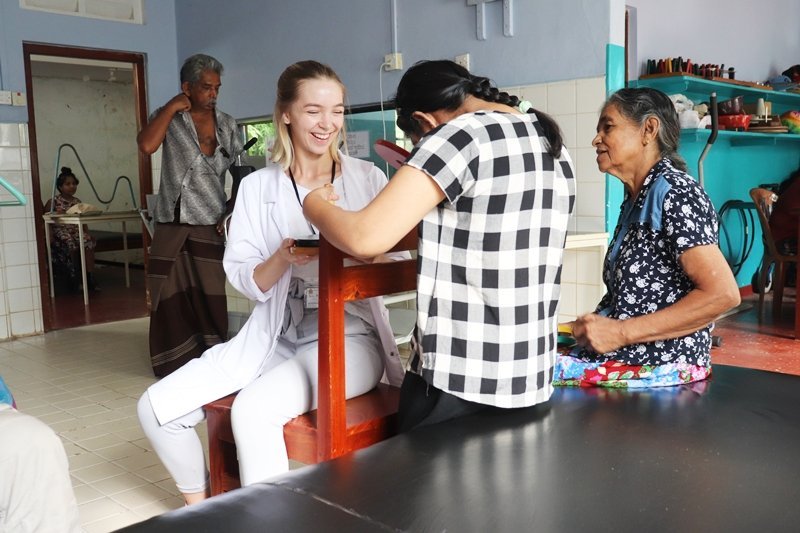 The World Health Organization estimates that 2.4 billion people worldwide live with a health condition that could benefit from rehabilitation. In some low- and middle-income countries, more than half of the people who need rehabilitation don’t receive it, and many settings have fewer than 10 skilled rehabilitation practitioners per million people. That gap shapes what you’ll see:
- Late presentation. You’ll see stroke, spinal cord injury, fractures and cerebral palsy at stages UK teams rarely meet, often with contractures that earlier physio would have prevented.
- Trauma and orthopaedics. Road-traffic injuries are a major workload in many of these countries, so post-fracture and post-operative rehab is common.
- Low-resource treatment. With little equipment, therapists rely on manual skills, improvised aids and family-delivered home programmes. This is useful training for community and NHS outreach work.
- Different models of care. In some countries the family provides much of the day-to-day care, physios may work on referral rather than direct access, and traditional medicine sits alongside physiotherapy. In Sri Lanka, for example, students can attend introductory sessions on Ayurvedic medicine.
Reflecting well on these differences, without judging them, is what makes a strong elective report. Our reflective report template was written for medics, but its structure works for physio too.
Where to go: comparing destinations for physiotherapy
Med Trips runs one dedicated physiotherapy programme and offers physiotherapy as a department on several multi-specialty placements. All of them are supervised by local staff and supported by our in-country teams.
| Destination | Physio setting | Language on the unit | Best for |
|---|---|---|---|
| Sri Lanka (dedicated programme) | Physiotherapy and rehabilitation services at National Hospital Galle, plus community, disability and elderly-care activities | Sinhala with patients; clinical English widely used by staff | Students who want a physio-specific placement with structured supervision, 1–8 weeks |
| Nepal | Physiotherapy department in a multi-specialty hospital rotation | Nepali; English among clinicians | Mixing physio with orthopaedics and trauma exposure |
| Ghana | Physiotherapy as a chosen department; open to physio and OT students | English (official) plus Twi and other local languages | An English-speaking setting; MSK and stroke rehab |
| Tanzania (Arusha & Zanzibar) | Physiotherapy among the hospital departments, alongside orthopaedics and theatre | Swahili; English among clinicians | Trauma and post-operative rehab in a busy public hospital |
| Cambodia | Physiotherapy within a rotation that also covers traumatology and orthopaedics | Khmer; interpreting often needed | Seeing rehab in a health system still rebuilding its workforce |
| Peru | Specialist-clinic option including physiotherapy and traumatology | Spanish (intermediate level strongly advised) | Spanish speakers who want Latin American practice |
If language matters most, choose Ghana or Sri Lanka. If you want the most physio-specific structure, the physiotherapy internship in Sri Lanka is purpose-built: placement at National Hospital Galle, supervision by senior physiotherapists, and a flexible 15–35 hours a week. Browse all our physiotherapy placements to compare.
What it costs
Expect four cost blocks: the programme fee (accommodation, meals, transfers, local support, and in our case medical insurance), flights, vaccinations and visa, and personal spending. As an example, the Sri Lanka physiotherapy programme was priced at the time of writing from US$1,120 for one week to US$2,128 for four weeks and US$3,472 for eight weeks. Flights, visa, vaccinations and personal spending are extra. Current prices in your currency are on our prices page, and our 2026 cost data breaks down the extras by region.
Funding is limited but it exists. The CSP Charitable Trust has offered awards of up to £2,000 to eligible student members, and many universities have travel or elective bursaries. Check current eligibility and deadlines directly with them.
Getting it approved: a step-by-step checklist
 Start 9–12 months ahead. The CSP itself warns the process can be time-consuming.
- Read your programme rules. Is there an elective? Can it be overseas? Will it count toward your 1,000 hours, or is it extra-curricular?
- Agree learning outcomes with your placement lead, e.g. “observe and discuss neurological rehabilitation in a low-resource setting”.
- Get supervision details in writing: the supervising physiotherapist’s name, qualification, registration body and contact details, and the hours you’ll be on the unit.
- Complete your university’s risk assessment using FCDO travel advice for the country. Our elective sign-off guide walks through the paperwork, which is very similar for allied health.
- Confirm insurance: CSP PLI (and check the excluded countries), travel and medical cover, and the provider’s liability arrangements.
- Book health prep early. Some vaccine courses take weeks, so see our vaccinations and visas timeline.
- Plan your evidence: a reflective log, a supervisor’s sign-off or attendance letter, and a post-placement report if your programme needs one.
Going as a cohort: physio societies and university groups
Physiotherapy schools and student societies increasingly run group placements. A cohort of students travels together, often with a member of faculty. This makes supervision, risk assessment and sign-off far simpler for the university, because one set of paperwork covers the group. If you’re a lecturer or society organiser, see our university group placements page and the step-by-step guide to organising a group elective. Mixed cohorts with nursing, medical and radiography students work well too, because rehab abroad is very multidisciplinary.
Why the provider you choose matters
A physio placement is only as good as its supervision. Before booking with any provider, ask three questions: Who exactly will supervise me, and what are their qualifications? What happens if I’m asked to work beyond my competence? Who supports me on the ground, 24/7? Med Trips is part of a certified B Corp group, which means independently verified standards of accountability. Our placements are built to be observation-appropriate for students, and in-country teams handle arrival, accommodation and day-to-day support so you can focus on learning.
Frequently asked questions
Do overseas physiotherapy placement hours count toward the CSP’s 1,000 hours?
Only if your university formally includes the placement in your programme and is satisfied with the supervision and quality assurance. Many treat overseas electives as extra to the 1,000 hours. Ask your placement lead before you book.
Does CSP insurance cover me abroad?
CSP student PLI covers supervised overseas placements of up to 180 days, anywhere except the USA, Canada and Australia. It covers malpractice only, so you still need travel and medical insurance. Always confirm current terms with the CSP.
Can I treat patients on a physio placement abroad?
Not on your own. You can help with exercise, mobility and group sessions under direct supervision, within the competencies you’ve been signed off for in the UK. Independent assessment or treatment isn’t appropriate for a student anywhere.
How long should a physiotherapy elective abroad be?
Most university electives run four to six weeks. Our Sri Lanka physiotherapy programme runs from one to eight weeks. Two weeks is the realistic minimum to settle in and see a range of cases.
Which country is best for a physiotherapy elective?
For a dedicated physio programme with English widely spoken by staff, Sri Lanka is the strongest option. Ghana suits students who want an English-speaking country. Tanzania and Nepal offer the most trauma and orthopaedic rehab.
Plan your physiotherapy placement
Compare dates and destinations in our programme search, or talk to our team about supervision, sign-off paperwork and what your university needs to see. Organising for a whole cohort? Start with our group elective page. Considering a different discipline? We also run dentistry, midwifery and pre-medicine placements.