 English ▾
 Nederlands
 English (US)
 Deutsch
 Italiano
 Português
 Español
 Français
 Most medical elective problems are not clinical. They are calendar problems. A rabies course that needed 28 days, a yellow fever certificate that only becomes valid ten days after the injection, an occupational health form that had to be signed before your medical school would release your sign-off, a hospital permission letter that a visa officer wanted to see — none of these are difficult, but every one of them has a lead time, and lead times do not care that your flights are booked.
This guide sets out the full pre-departure sequence for a UK medical, nursing, dentistry, physiotherapy or midwifery student: when to start, what vaccinations you are likely to need and why, how visas and clinical permissions differ, and what to do about blood-borne virus exposure — the one plan almost nobody makes and the one that matters most if it happens.
A note on currency: immunisation schedules, entry rules and country risk ratings change. Everything below is a planning framework, not a substitute for a personalised travel health consultation. Always confirm current details against TravelHealthPro (NaTHNaC), NHS Fit for Travel, your university’s occupational health service, and the official entry requirements for your destination, close to the date you travel.
The 18-month pre-departure timeline
Electives fail on sequencing far more often than on effort. The single most common mistake is treating vaccinations as a “few weeks before” task, when several courses run over a month and some need to be scheduled around your academic year. Work backwards from your placement start date.
| When | What happens | Why it has to happen then |
|---|---|---|
| 18–12 months out | Choose destination and specialty; read your medical school’s elective regulations; check minimum duration and whether the placement must be clinical | Your school’s rules determine what is even eligible. Popular hospital departments fill a year ahead |
| 12–9 months out | Secure the placement and get a named supervisor in writing; submit the elective proposal form for approval | Sign-off is the gate everything else passes through — see our guide to the UK elective approval process |
| 9–6 months out | Check passport validity (six months beyond entry is the usual bar); confirm the visa route; start applying for bursaries and grants; budget properly | Most elective funding has fixed deadlines and pays in arrears. Passport renewals are the classic silent delay |
| 6–4 months out | Book the occupational health appointment; request evidence of your childhood immunisations and hepatitis B status | OH clearance is often required by your school, not just by the host hospital, and records take weeks to retrieve |
| 4–3 months out | Book flights; arrange insurance and check indemnity; confirm accommodation | Airfares climb steeply inside 90 days, and insurers want the itinerary |
| 12–8 weeks out | Travel health consultation. Begin any multi-dose courses (e.g. rabies pre-exposure) | A travel health appointment is generally advised 8–12 weeks before departure; a three-dose rabies course typically runs over 21–28 days |
| 4–2 weeks out | Complete vaccine courses; collect the yellow fever certificate if needed; collect malaria tablets; register with your government’s travel advice service | A yellow fever certificate is only valid from ten days after vaccination |
| Final week | Print and duplicate every document; brief your emergency contact; confirm airport pickup; start malaria prophylaxis if the regimen requires it | Some regimens start days before arrival, others weeks before |
Vaccinations: two separate layers, two separate appointments
 Students routinely conflate these, then discover in week one that the host hospital wanted something the travel clinic never discussed. You need both, they come from different places, and only one of them is destination-driven.
Layer one: occupational health
This is about protecting you and patients in a clinical environment, and it applies regardless of where you go. Your university occupational health department will typically want evidence of your routine UK immunisations, BCG or tuberculosis screening status, varicella immunity, and — the one that generates the most correspondence — hepatitis B.
Hepatitis B is worth understanding rather than just ticking. An anti-HBs level of at least 10 mIU/mL is the internationally used marker of a response to vaccination. UK practice for healthcare workers undertaking exposure-prone procedures has historically looked for a post-course level of 100 mIU/mL or above, and students whose levels fall below the response threshold are usually offered a booster and re-tested. Antibody levels also decline measurably over the years following the primary course, which is why a student vaccinated as a fresher may get an unexpected result in year four. If you are a documented non-responder, that is not a reason to cancel — it is a reason to have the conversation early, because it changes what happens after an exposure.
Layer two: travel health
This is destination-driven and comes from a travel clinic, your GP practice, or a pharmacy travel service. Expect the discussion to cover hepatitis A, typhoid, tetanus/diphtheria/polio boosters, and — depending on the country — yellow fever, rabies, Japanese encephalitis, meningococcal ACWY, and malaria chemoprophylaxis.
Two points that specifically matter for healthcare students:
- Rabies pre-exposure vaccination is a different calculation for you than for a tourist. Pre-exposure vaccination does not remove the need for treatment after a bite, but it does remove the need for rabies immunoglobulin — which is expensive, frequently unavailable in the exact regions where rabies risk is highest, and the component most likely to require an emergency flight home. It also reduces the number of post-exposure doses needed. The usual course is three doses over 21–28 days, so it must be started early.
- Yellow fever has a hard date attached. Since 11 July 2016, the International Certificate of Vaccination or Prophylaxis has been valid for the life of the person vaccinated — boosters are no longer required as a condition of entry. But the certificate only becomes valid ten days after the injection, and it must be issued by a designated yellow fever centre.
Malaria prophylaxis: start dates differ by drug
This is not a “pick one up at the airport” item. Atovaquone–proguanil and doxycycline are generally started 1–2 days before entering a risk area; atovaquone–proguanil is continued for 7 days after leaving, whereas doxycycline is continued for 4 weeks. Mefloquine needs to be started several weeks ahead — commonly quoted as 2–3 weeks and sometimes longer — partly so that side effects can be assessed before you are committed. On a long elective, the total tablet cost is material and belongs in your budget, which is why we itemise it in our line-by-line cost breakdown.
What the NHS pays for
The NHS-funded shortlist at a GP practice is short and generally covers vaccines with a UK public health rationale — typically hepatitis A, typhoid, cholera and polio-containing boosters. Yellow fever, rabies, Japanese encephalitis, meningitis ACWY and hepatitis B are usually charged privately, with per-dose prices commonly in the £50–£100 range plus a consultation fee, and rabies needing three doses. Budget £150–£400 for a typical tropical destination, and considerably less for Europe. Booking the free items at your GP and the private ones in a single pharmacy appointment is the cheapest sensible route.
Blood-borne virus exposure: make the plan before you need it
This is the section to read twice. Needlestick and sharps injuries are not rare among students — reported occupational exposure during undergraduate medical training ranges widely across studies, with figures between roughly 11% and 50% of students, reflecting inexperience more than carelessness. Abroad, the background prevalence of blood-borne viruses may be higher and the local reporting pathway will be unfamiliar.
Before you fly, you should be able to answer all five of these:
- Who do I tell, on site, within the hour? Get the name and number of the person at the placement who handles occupational exposure, not just the department you’re in.
- Where is the nearest facility that stocks HIV post-exposure prophylaxis, and how do I get there at 2am? PEP is time-critical — hours, not days.
- Does my insurance cover it? Check that emergency medical treatment and repatriation are included and that there is a 24/7 number that a colleague could call on your behalf. Our guide to elective insurance and indemnity covers what UK students actually need, including why medical insurance and professional indemnity are two different products. Med Trips includes medical insurance in the programme fee; indemnity for your own clinical activity remains yours to arrange, usually free through a UK defence organisation’s student membership.
- Who at my medical school do I notify, and how fast? Most schools require prompt notification and will support you from the UK.
- What is my hepatitis B status, in writing, in my bag? The clinician assessing you abroad will ask, and “I think I had it” is not an answer that helps them.
Alongside this, know your scope. A supervised elective is not an opportunity to attempt procedures beyond your training — a boundary we treat as non-negotiable, and one of the reasons our placements are structured as supervised, observation-appropriate learning with named clinicians rather than unsupervised ward cover. It is also the honest answer to the ethical questions we set out in our guide to elective ethics.
Visas and permissions are three different things
 Students often assume one document covers everything. In practice a placement abroad involves up to three separate permissions, and they are granted by different bodies on different timescales:
- Immigration permission — the visa or entry authorisation that lets you into the country, covered in more detail in our post on whether you need a visa for a medical elective. Route and processing time vary; some destinations use an online authorisation issued in days, others require a physical application well in advance.
- Hospital or institutional permission — the host’s own acceptance letter naming your supervisor, dates and department. This is what your medical school signs off against, and often what an immigration officer wants to see.
- Professional or regulatory permission — in some countries, an observer permit or a registration step with a local medical or nursing council before you can be on the ward at all.
The table below shows the typical planning position across our destinations. Treat it as a prompt for the right questions, not as entry advice — requirements change and depend on your nationality, your route, and where you have travelled previously.
| Destination | Yellow fever certificate | Malaria prophylaxis usually discussed? | Planning note |
|---|---|---|---|
| Ghana | Commonly required of all arrivals | Yes | Start the yellow fever step early — the certificate needs 10 days to become valid |
| Tanzania | Usually if arriving from a risk country | Yes | Hospital permission letters carry weight; keep printed copies |
| Kenya | Usually if arriving from a risk country | Yes, varies by region | Risk differs sharply between highland and coastal placements |
| India | Usually if arriving from a risk country | Region-dependent | Confirm the correct visa category for a clinical observership, not a generic assumption |
| Nepal | Usually if arriving from a risk country | Low in Kathmandu; higher in lowland areas | Altitude, not just infection, belongs in your risk assessment |
| Sri Lanka | Usually if arriving from a risk country | Generally not — WHO certified the country malaria-free in 2016 | Online entry authorisation is the usual route |
| Thailand · Vietnam · Cambodia | Usually if arriving from a risk country | Mainly rural and border areas | Dengue prevention (bite avoidance) often matters more than tablets |
| Peru | Recommended for jungle regions | Amazon regions | Requirements differ between Lima, Andean and Amazon placements |
| Morocco · Greece | Not routinely required | No | Simplest paperwork of our destinations — good for short or first electives |
The document bundle you actually travel with
Carry paper. Phones run out of battery in the exact places where you need the document, and some officials will not accept a screen. Duplicate everything: one set in your hand luggage, one in your main bag, one scanned to a family member.
- Passport (validity comfortably beyond your return) plus a photocopy of the ID page
- Visa or entry authorisation confirmation
- Hospital acceptance and supervisor letter, with dates
- Your medical school’s elective approval and any indemnity confirmation
- Insurance policy number and the 24/7 assistance line
- Immunisation record, hepatitis B status, and the yellow fever ICVP if applicable
- Emergency contacts — UK and in-country — and your accommodation address
Add the clinical items you will actually want on the ward from our elective packing guide, and remember that a good provider should be sending you a destination-specific pre-departure pack rather than leaving you to assemble this alone. That is part of what our in-country teams do at the receiving end — meeting you, orienting you at the hospital, and being reachable when something changes.
If you are organising this for a group
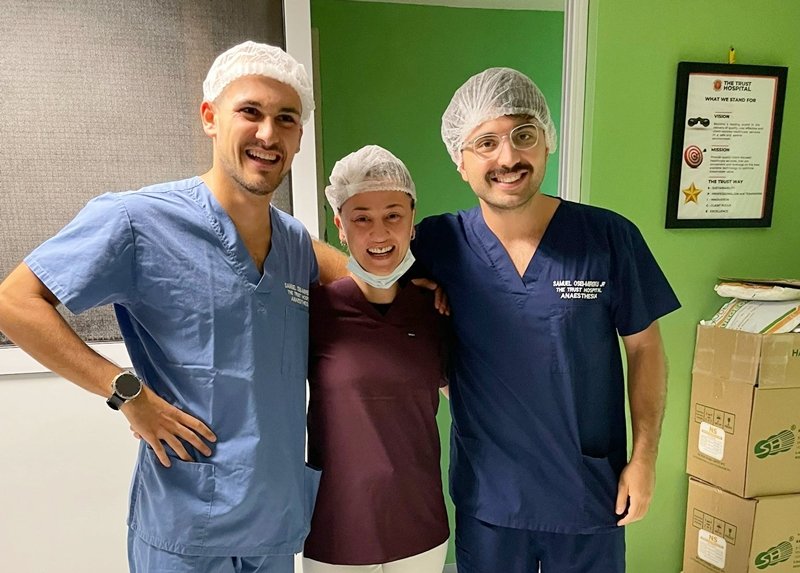 Everything above multiplies awkwardly across twenty students. Vaccination schedules diverge, passports expire on different dates, and one person’s missing occupational health form can hold up an entire cohort’s approval. Faculty leads and MedSoc organisers should build a single tracked matrix — student, passport expiry, visa status, OH clearance, vaccination completion, insurance — and set an internal deadline four weeks ahead of the real one.
If you are organising a group elective for your university or medical society, we manage that matrix with you, provide the documentation your institution’s risk assessment process needs, and work to a single group timeline. Our guides to organising a group elective and safeguarding and risk assessment for university groups go into the institutional detail, and as a B Corp we are held to published accountability standards on how those placements are run.
Frequently asked questions
How early should I book my travel health appointment?
Aim for 8–12 weeks before departure, and earlier if rabies pre-exposure vaccination is likely, because that course typically runs over 21–28 days. If you leave it to the final month you may still travel, but you may not complete every course, and some protection is schedule-dependent.
Do I need a new yellow fever vaccination if mine is old?
For entry purposes, no. Since July 2016 the certificate has been valid for the life of the person vaccinated, and boosters are not required as a condition of entry. A small number of clinical situations still prompt a clinician to consider revaccination, so raise your history at the consultation.
What if my hepatitis B antibody level is below the threshold?
Speak to occupational health early rather than cancelling. Students below the response threshold are usually offered a booster and repeat testing, and documented non-responders can still travel — the difference is that the post-exposure plan changes, so it needs to be agreed in advance.
Are travel vaccinations free on the NHS?
Some are. Hepatitis A, typhoid, cholera and polio-containing boosters are typically NHS-funded at a GP practice. Yellow fever, rabies, Japanese encephalitis, meningitis ACWY and hepatitis B are usually private, commonly £50–£100 per dose plus a consultation fee. Budget £150–£400 for a tropical destination.
Does a tourist visa cover a clinical elective?
Sometimes, but never assume it. Immigration permission, hospital permission and any local regulatory registration are three separate things. Ask your placement provider in writing which route applies for your nationality, and get the hospital’s acceptance letter well before you apply.
Start the sequence, not the shopping list
Pre-departure preparation is easier than it looks once you accept that it is a sequence with fixed lead times rather than a to-do list you can compress. Get the placement and the sign-off first, then occupational health, then travel health, then documents — in that order, with a month of slack built in.
Med Trips runs supervised placements across medicine, nursing, midwifery, dentistry, physiotherapy, radiology and pre-medicine in twelve countries, with medical insurance included in the fee and in-country teams who meet you on arrival. You can browse placements by specialty and destination, see exactly what is and is not included on our pricing page, or read about who we are and how we work.
Planning an individual elective? Talk to our team and we will send the destination-specific pre-departure pack for the placement you are considering. Organising one for a cohort? Start with our university group placements page and we will build the timeline around your academic calendar.